


|
Calendar Veda Loka
2026 THE YEAR OF DHARMA PREACHING
20 September
Sunday 2026 year 00:00:00
Time
chronology 5121 years of Kali Yuga,
28th Mahayuga 7th Manvantara The era of Manu Vaivasvata boar Kalpa first day of 51 years of the great First-God-Creator |
||


|
Latest Updates
|
||
|
Video Updates
|
||
Tree of Teaching
The Teaching of Laya Yoga is like a giant, beautifully flowering tree, which has roots, a trunk, branches, leaves, flowers, and fruits. All Teaching methods are located in their place; they are perfectly combined and harmoniously coexist in the Tree of Teaching without contradictions. Everything in it has its function, purpose and goal.
- Prajna Yantra
- Shakti Yantra
- Nada Yantra
- Jyoti Yantra
- Nidra Yantra
- Methods-leafs
- Methods-flowers
- Fundamental categories of the Teaching
- The Natural State, Contemplation and the Three Freedoms
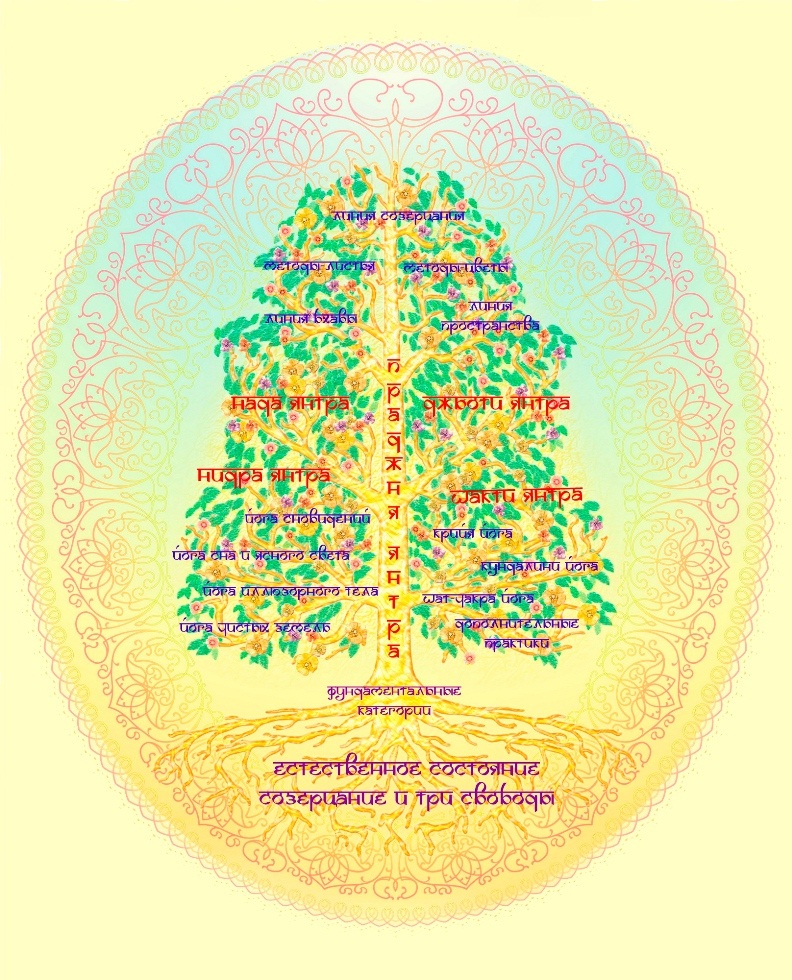
There are five main directions in the Teaching: Wisdom (Prajna Yantra), Energy (Shakti Yantra), Dream Yoga (Nidra Yantra), Light (Jyoti Yantra) and Sound (Nada Yantra).
If we imagine the entire Tree of Teaching as a whole, then the roots here are three awarenesses or three freedoms - body, speech and mind. The three freedoms mean we are in a natural, liberated, unconditional state. It is not conditioned either in the body, speech, or thoughts, and being in such a state is the root of the Teaching.
But a tree also has a trunk, and the methods of the trunk are the methods of Prajna Yantra (the Teaching of Wisdom). These are the methods of the contemplation section - such as working with sankalpas, the art of Mahashanti or the nine self-liberations, the Divine Pride section, and the Shambhavi mudra section. These are the main methods related to the trunk of the Tree of Teaching. That is, the essence of the Teaching is to contemplate, be aware, and remain in a self-liberated presence.
There are also branch methods. These are special, skilful methods that allow you to develop and deepen contemplation. The branch methods are Shakti Yantra (the Teaching of Energy), Nada Yantra (the Teaching of Sound), Nidra Yantra (the Teaching of Dream Yoga) and the Teaching of Light (Jyoti Yantra).
There are so-called leaf methods (additional small methods). There are many of them, like leaves on a tree. Leaf methods are not the main methods, not the root ones, but they help us develop our contemplation, one or another aspect of practice.
And there are flower methods. Flower methods express the aspect of pure vision, the aspect of the flowering of Dharma. They are like beautiful flowers on the Dharma tree. These include, for example, the sadhana of invoking Dattatreya, Lakshmi.
The Teaching and practice of Dharma is not a single method; it is a tree method, representing multidimensionality, an extensive system, multivariance, and polyphony. Teaching is not some philosophical principles or two or three methods; it is a whole big tree. In this tree, it is essential to understand what is the trunk, what is the roots, what is the leaves, and what is the flowers. If we do not understand the hierarchy of methods in diversity, we may not understand what emphasis to place and on what, what is the place of each method in the Teaching.
But if we clearly understand that the root is being in the natural state, then it is clear that the essence of the Teaching is indefinable and lies in staying in awareness. If you understand that there is a development of contemplative practices, then it is clear what this tree rests on, what is its trunk. And when we apply other methods, we learn to weave and practice them in the context of understanding the Tree of Teaching.
The Tibetan saint Tilopa gave the following instructions: “Use not one method, but many.”
Why are multiple methods needed? The multitude of methods is an apparent multitude and diversity. There is one method, and we are practitioners of one method. And this primary method is to remain in a contemplative presence (Sahaja-sthiti). That’s why our direction is also called Sahajya, the school of Sahajya. The principle of Sahajya is the direct, immediate experience of non-duality. The Siddhas of Sahajayana taught that reality cannot be understood through method, action, conceptual limitations, or philosophy.
Staying in the state of Sahajya is the root of the Teaching; that is, first of all, we listen to the internal spontaneity of natural awareness, and secondly, we do techniques, perform ritual practices, methods, etc. But if you perform many techniques and rituals, chantmantras, wear a particular type of clothing, perform worship, but you do not have the practice of awareness, i.e. you are not in this spontaneity, which means that you still cannot get into the dimension of the Teachings of Laya Yoga.
As we remain in the natural state and learn to be mindful, to integrate contemplative presence with the various manifestations of our life, a surrender to this natural state gradually begins. The state of nature is not associated with logic, philosophy, culture, or any religious tradition. Instead, this is the essence of our world, the essence of the Universe, also called Prajnana (primordial wisdom of awareness), Parabrahman. As we become rooted in the natural state, our mind trusts it more and surrenders more and more.
The Teaching of Prajna Yantra, which is the trunk, describes the processes of self-liberation and self-transcendence. It teaches us how to practice correctly to enter into these processes.
The section of the Prajna Yantra dealing with divine pride emphasizes pure vision, the Pride of the Divine (divya bhava). The section on Shambhavi mudra emphasizes space and contemplation of space. The contemplation section is associated with the Teaching of “The Nine Sankalpas”, the nine self-liberations; it teaches us to work with the mind and apply subtle methods that would eliminate the clingings of our mind. All these three sections only seem different; they all lead to the same thing, although they have their own characteristics and methodology.
We study and practice these three sections throughout our lives because they are essential to understand. If you enter into the Teachings of Laya Yoga, you need to understand these sections thoroughly. They have nothing to do with speculative philosophy. These are practical sections, and they only talk about how to engage in practice, contemplation, to eliminate ignorance. And if you correctly understand the Teachings of the Prajna Yantra, then you can easily fit any other methods and integrate them into the general context of practice.
The Teaching has a rather sophisticated structure and many methods, but all the structure and methods are intended only for convenience and understanding; in fact, all sections of the Teaching speak only about one thing: how to remain in our original nature. Why are so many methods and such skilful means needed? Because we have gone very far from our original nature, and even when we hear about it, it is not so easy to return to it, we have gone very far from it, very seriously. Our original nature, Sahajya, the Supreme Source, God, Brahman, and the Absolute are identical concepts. All we need is to learn to return to this nature.
Contacts of "Worldwide Sanatana Dharma Community":
Omkar +380684188899 (Telegram, Viber, Whatsapp)