


|
Calendar Veda Loka
2026 THE YEAR OF DHARMA PREACHING
20 September
Sunday 2026 year 00:00:00
Time
chronology 5121 years of Kali Yuga,
28th Mahayuga 7th Manvantara The era of Manu Vaivasvata boar Kalpa first day of 51 years of the great First-God-Creator |
||


|
Latest Updates
|
||
|
Video Updates
|
||
Canon of texts
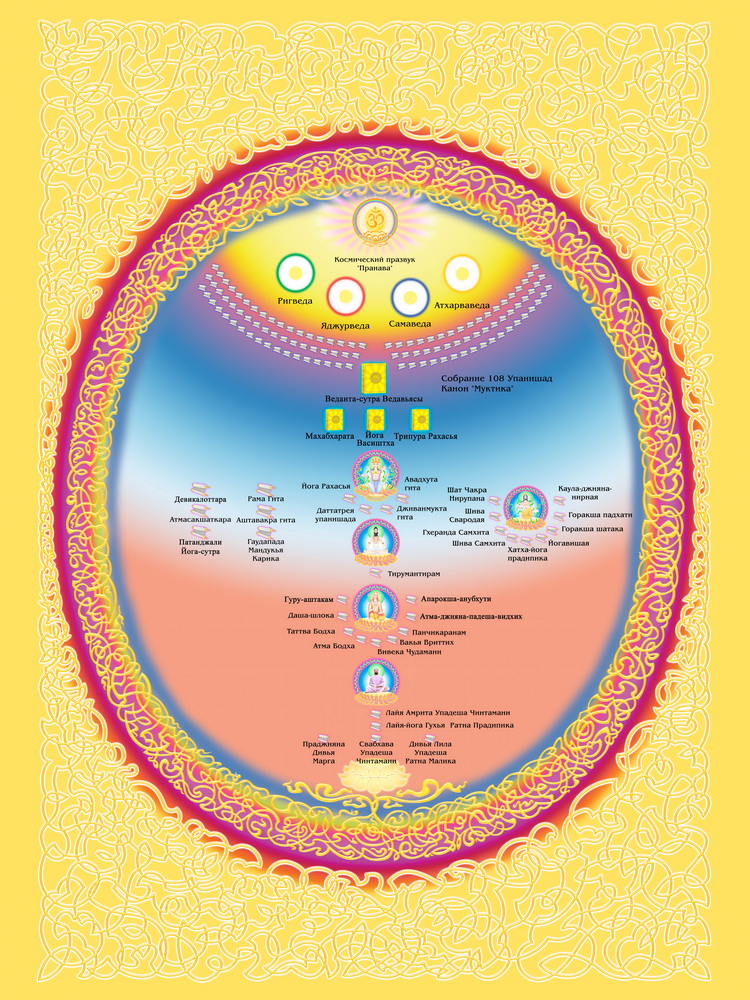
“We belong to the Vedantic tradition. The Vedantic tradition is the cream of the Vedic tradition, the completion of the Vedic tradition. The Upanishads are parts of the Vedas, not in the sense that it is the end, but in the sense that it is the apogee, the peak. The principle of the Vedantic tradition always stands on the foundation of the Upanishads, Puranas, and Itihasas. Yoga Vasishtha - refers to Itihasas. Tantras and Upadeshas follow from the teachings of the Upanishads outlined in Advaita.
It is believed that there are 108 main Upanishads. Initially, there were 1180 of them, and the 4 Vedas contained them, but then many of them were lost. The sage Vyasa classified and added the most famous ones to each of the Vedas. And now 108 non-dual Upanishads have survived to this day. This is the so-called Muktika canon - the liberating Upanishads.
Shankaracharya selected 10 Upanishads out of 108 and made them famous and popular. It was from the Upanishads that Shankara developed his teaching of Advaita Vedanta. Thanks to the inspiration of these Upanishads, his famous texts appeared: Viveka Chudamani, Atma-bodha, Tattva-bodha, Brahmanam Chintanam and others.
Many saints fear that these 10 Upanishads will be forgotten, resulting in a spiritual and moral disaster since these 10 Upanishads determine the future fate of human civilisation. Human civilisation stands at a crossroads: degradation or development into super-civilisation and glory, the transition to God-manhood. Our teaching is also connected with these Upanishads - it is a development of them and stands on their foundation. However, nothing can harm the Vedas. Scientists, saints, and believers must join forces and reveal to humanity the meaning of at least these 10 Upanishads. We also take part in this. The names of these Upanishads are Isha, Katha, Prashna, Mundaka, Mandukya, Taittiriya, Aitareya, Chandogya, and Kena Upanishad. There are also other 98 Upanishads: Brahma, Kaivalya, Hamsa, Garbha, Varuni, Paramahamsa, Amritananda, Narayani, Amrita-bindu, etc.
In addition to containing the essence of the Advaita Vedanta view, the Upanishads were the source of inspiration for many ancient works on geography, astrology, astronomy, and even the theory of economics and politics. The Upanishads also inspired the 18 Puranas. Puranas are ancient myths and legends. For example, Bhagavata Purana, Devi Purana, Vishnu Purana. From them came the Skanda Purana, Shiva Purana, Garuda Purana and others.
Mandukya Upanishad is the core of Vedanta. In terms of the depth of its content, it is incomparable with other Upanishads, and knowledge of it alone is considered sufficient to achieve liberation. If you want to establish yourself in your view, read the Mandukya Upanishad - the most important of the canon of 10, 108, and 1108 Upanishads. It is very short - it consists of only 12 mantras and is divided into four parts. The first part is devoted to the interpretation of Om Pranava - a secret teaching that is the key to self-realisation. The second part discusses and refutes the dualistic doctrine - the main obstacle to liberation. The third part preaches Advaita - the philosophy of non-duality and unity. The last part is devoted to analysing and criticising contradictory philosophical systems that are not based on the teachings of the Vedas.
The Vedas and Upanishads are the very basis of Sanatana Dharma. The Vedic religion, Vedic knowledge does not have a specific date or founder. Christians have Christ as their founder. Christianity is 2,000 years old. Buddhism has its founder, Buddha. Buddhism is 2500 years old. In Islam, the founder is the prophet Muhammad. Islam is 1400 years old. The invisible founder of the Vedas - Apurusheya - means non-human, the Divine Source itself. Vedic knowledge has no beginning, no end, no one founder. This Supreme Source of all wisdom is the prophet of Sanatana Dharma.
It is believed that when human wisdom declines, blessing wisdom descends through sages and saints and again restores Vedic knowledge according to the sankalpa of the Creator, Brahman. Believes that through these Upanishads Bhagavan, the Supreme Source bestowed Satya-Jnana to humanity, i.e. wisdom based on truth.”
Swami Vishnudevananda Giri
Contacts of "Worldwide Sanatana Dharma Community":
Omkar +380684188899 (Telegram, Viber, Whatsapp)