


|
Calendar Veda Loka
2026 THE YEAR OF DHARMA PREACHING
23 October
Friday 2026 year 00:00:00
Time
chronology 5121 years of Kali Yuga,
28th Mahayuga 7th Manvantara The era of Manu Vaivasvata boar Kalpa first day of 51 years of the great First-God-Creator |
||


|
Latest Updates
|
||
|
Video Updates
|
||
Introduction
Having completed the basic entry-level practices,
one should proceed to the following activities:
1. Asana complex #1: thirty times.
2. Sahita kumbhaka pranayama, the three mudras – ninety sessions of two hours (thirty minutes of pranayama and thirty minutes of each mudra).
3. Sukshma Dharana (concentration on Om, on a seed syllable, or on Ishta Devata) – thirty sessions of 90 minutes for each dharana.
4. Gayatri mantra: one hundred thousand times.
5. Datta Gayatri mantra: one hundred thousand times.
6. Dattatreya's seed mantra (Om dram Dattatreyaya namaha): one hundred thousand times.
7. Chandali Yoga meditation: ten thousand circles.
8. Mahashanti: thirty sessions of 90 minutes.
9. Shambhavi mudra: thirty sessions of 90 minutes.
10. Chankramanam (contemplative walking) - thirty sessions of one hour.
11. Tantric Theurgy #4: thirty sessions.
All these methods will purify the body and mind, untie the knots in the channels, awaken the flow of divine blessings from the lineage and the Tree of Refuge, and prepare the mind for genuine meditation.
Task 1. Asana complex #1 (30 times)
Basic asana complex
This specially selected asana combination is designed to purify and unknot the channels (Nadis), awaken the Kundalini, and open the Muladhara Chakra. By doing it daily, one can transform oneself into an energetic person with good health. And if done in combination with other Yoga Tantra practices, it can certainly lead to Kundalini energy awakening and to the mystical experience of the subtle body visiting other worlds.
Pay particular attention to keeping the spine straight during non-bending exercises while performing this asana set. Each asana takes about one minute (if duration is not purposely specified). As you master this set, you can adjust the duration of the asanas yourself.
1. Griva Shaktivardhak (head rotation)
Alternative 1
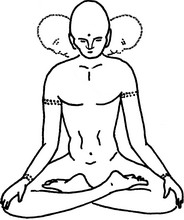
Assume a seven limbs pose. Make slow circular movements with your head clockwise. Complete 10 rotations. Make 10 rotations counterclockwise. Seek to work up the cervical vertebrae well.
Alternative 2
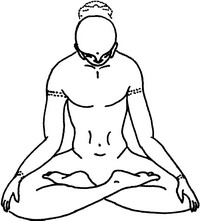
Make 10 head up and down movements: 10 up, 10 down.
Alternative 3
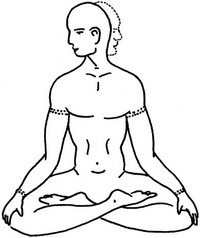
Do 10 energetic turns of the head to the right and left.
Benefit:
– this exercise prepares the neck muscles for prolonged practice of inverted asanas, so always perform Griva Shaktivardhak before Viparita Karani (Exercise 30);
– regular practice of Griva Shaktivardhak, especially prolonged, cures throat diseases associated with abnormal flow of energy in the Vishuddha Chakra area, because this practice purifies the karma of speech at the energy level;
– When done for a long time, this exercise can bring about the experiences of Yoga of the Illusory Body (this Yoga is associated with the Vishuddha Chakra). Such episodes may include, for example, experiencing the Asuras’ or Gods’ worlds in a dream sleep.
2. The Mandukasana (Frog Pose)
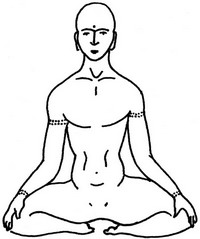
Sit on your heels with your knees as far apart as possible.
Keep your back upright.
Perform the Mula Bandha (Lesson 7), Nabho Mudra (Lesson 6), and Bhrumadi Drishti (staring into the interbrow) – these will increase the upward energy flow and clean the energy channels (Nadis).
3. The Simhasana (Lion Pose)
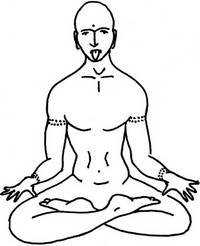
Assume a seven limbs pose – Sukhasana, Siddhasana, Vajrasana, or Padmasana.
Open your mouth and stick your tongue out as much as possible.
Spread your fingers out to the sides.
Hold the palms tensed above the knees for 1 minute.
Benefits: This asana is very good for curing all throat ailments, such as sore throat or illnesses related to the Vishuddha Chakra.
It also promotes a strong energy boost.
Sometimes you may feel nauseous while performing this asana. This is indicative of energy uprise to the upper chakras.
4. The Vakrasana (Twisting Pose)
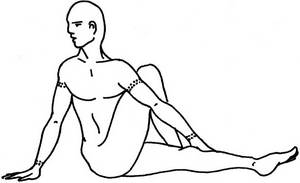
Sit with both legs stretched forward.
Bend your left leg at the knee and put it behind the knee of the right leg.
Put your right hand over your left knee and grab your left foot with the right hand.
Turn your body as far to the left as possible and place your left hand behind you as a support.
Turn your head as far to the left as possible, looking up.
Having finished with this side, switch the legs.
5. The Matsyendrasana (Matsyendra’s Pose)
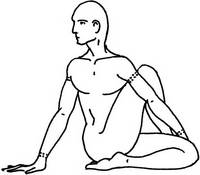
This pose is performed exactly the same way as Vakrasana. The only difference is in bending of the straight leg and placing it next to the buttock. The leg must be fully pressed to the floor.
Twist the body in the same way as in the Vakrasana.
Having done the exercise, switch the legs.
Benefits: the Vakrasana and Matsiendrasana increase the flow of prana to the internal organs. So, all the body organs are equally supplied with energy.
For example, when we turn to the left, the left side of the body contracts. Then, when we turn to the right, it stretches, and the organs start to be intensively supplied with prana.
This way, the blockages in the Nadis on both sides are removed.
The nadis are cleared, and the energy flows freely and without effort.
6. The Matsyasana (Fish Pose)
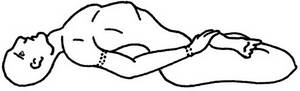
Sit in the Padmasana or, if you can not, in the Sukhasana, and lie back on the floor.
Arch your back and put your head on top. Grab your toes if you're in Padmasana.If you're in Sukhasana, just lean on your elbows and lay your hands along your body.
Benefits: Matsyasana is an excellent pose for correcting spinal curvatures and scoliosis. It also rejuvenates the body.
Our body has a mystical Moon in the area of the upper palate. This Moon oozes the nectar of immortality, but this nectar incessantly burns off in the fire of the inner Sun, which is in the Manipura Chakra. Due to this, our body ages.
However, certain asanas and mudras promote the opposite process – the accumulation of nectar in the body and body rejuvenation.
The Matsyasana is one of those asanas.
7. The Ardha Kurmasana(Half Turtle Pose)
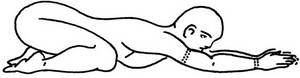
Sit on your heels and spread your knees as wide as possible. Put your palms together.
Lie on the floor. Stretch forward your hands with the palms put together.
Do your best to touch the floor with your chest while keeping your buttocks on your heels.
Look ahead with the "frontal gaze" (Bhrumadi Drishti), as in the other asanas.
8. The Kurmasana (Turtle Pose)
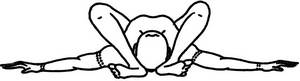
Sit with your legs stretched out in front of you.
Bend forward, putting your hands under your knees as far as possible. Try to touch the floor with your head.
9. The Kukkutasana (Rooster Pose)
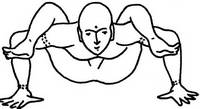
While in the previous pose, lift yourself up on your hands so that the body balances on the hands only.
Keep your legs as straight as possible.
Hold this position for 30 seconds.
10. The Ardha Ustrasana (Half Camel Pose)
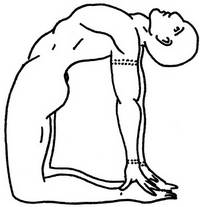
Get on your knees and, arching your back, grasp your heels with both hands.
Bend back as much as you can.
Benefits: this asana complex is developed so to untie the knots in the spine.
For that to happen, poses with forward and backward bends follow each other.
This makes the spine flexible, which can both eliminate scoliosis and completely clean up the central channel as well.
11. The Pashchimottanasana (Extended Back Body Pose)
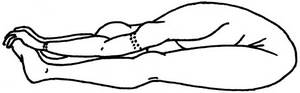
Sit with your legs stretched out in front of you.
Grasp the toes with your fingers and lean forward as much as possible, trying to reach your knees with the head.
Benefits: This pose is one of the most efficient in this asana set.
The yoga tantras say that by doing it daily for three hours, one can awaken the Kundalini and enter Samadhi.
Also, the Pashchimottanasana cures all stomach disorders and intensely fuels the digestion fire (a strong element of fire builds an opportunity for Kundalini awakening. For this reason, the scriptures do not recommend cold food and drinks).
12. The Bhujangasana (Snake Pose)
Alternative 1
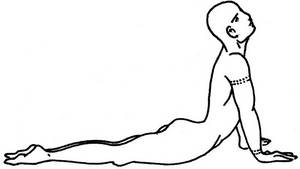
Lie with your face down.
With your palms on the floor at the shoulder level, slowly rise yourself up with a breath. First, lift your head off the floor, then gradually raise the rest of your body.
Bend as much as possible and remain stable in this position.
Keep the leg and buttock muscles tensed, as this will ensure better energy rise.
Hold this position for a while, and slowly begin to lower yourself with an exhalation.
At the end of the exhalation, slowly place your head on the floor.
Have a little rest lying on the floor, then start doing the asana all over again.
Perform this exercise several times.
Alternative 2
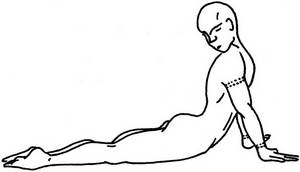
Lift yourself up as described above, then turn your head as much as possible to the left, looking over your left shoulder at the heel of your right foot, while keeping your body straight (only the neck turns).
Then turn the head back to the straight position and turn it as far to the right as possible, looking over the right shoulder at the heel of the left foot.
Then turn the head back to the straight position and, with an exhalation, slowly lower yourself to the floor.
Benefits: the Bhujangasana is a great exercise for correcting spinal curvatures.
It also intensely fuels the digestion fire and cures stomach disorders.
This pose awakens the Kundalini shakti.
13. Dhanurasana (Bow Pose)
Alternative 1
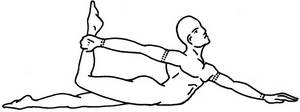
Lie on the floor belly down. Stretch your left arm forward.
Grab your right foot with your right hand and arch your back, raising your leg and upper body as high as possible.
Hold this position for 30 seconds.
Return to the initial position and do the same with the other leg.
In between, rest for a few seconds in the Makarasana (Crocodile Pose): lying on the floor belly down, put your left palm on the floor at the head level, put your right palm on top of it, and put your right cheek on the back side of the right palm.
This is a relaxation pose.
It helps relax deeply and restore the natural breathing rhythm.
Alternative 2
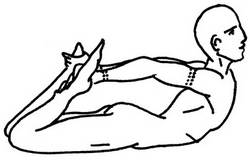
Initial position: lie belly down.
Bend your knees, place your heels over the buttocks and grasp the feet with your hands on the inside.
Lift your head and chest off the floor, trying to press your heels to the floor.
Stay in this position for a while, then slowly return to the initial position.
Benefits: the second Dhanurasana alternative, sometimes also called Mandukasana (Frog Pose), promotes inner energy activation by pressing on the Kanda.
Kanda is the area located twelve fingers above the Muladhara Chakra. It’s the root of all energy channels in the body.
Pressure on the Kanda activates the Kundalini energy.
Rest for a few seconds in the Makarasana.
Alternative 3
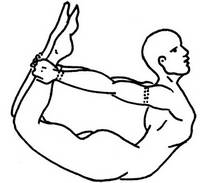
Grab your ankles and bend backwards.
Hold this position for 30 seconds, then rock back and forth / right and left on your stomach (if you wish).
Rest for a few seconds.
Benefits: this asana is also the best for cleaning of the central channel.
It promotes strengthening of the fire element.
14. Salabhasana (Locust Pose)
Alternative 1
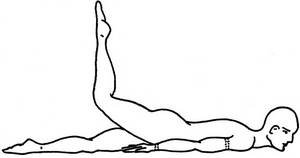
Initial position: lie on your belly.
Place your hands with the fingers squeezed together in fists along your body or under your hips.
Resting on your hands and chin, lift the right leg up as much as possible.
Hold this position for 20 seconds. Then put the right leg down on the floor and lift the left leg for the same amount of time.
Alternative 2
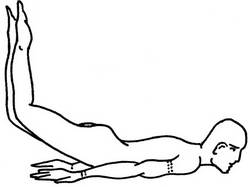
Then, with a little rest, raise both legs up (with the leg muscles tensed), and stay in this position for 20 seconds.
Then lower your feet to the floor and rest for a few seconds.
Benefits:
This pose places pressure on the Kanda, which activates the inner Kundalini energy.
The Salabhasana promotes purification of the channels (Nadis) in the head, upper, and lower Chakras.
15. Supta Vajrasana (Lying Diamond Pose)
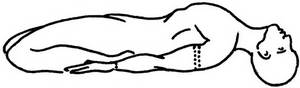
Sit with the buttocks on the heels, the knees put together.
This pose is called the Vajrasana.
Slowly lie back on the floor, with the arms along your body.
16. Gomukhasana (Cow Head Pose)
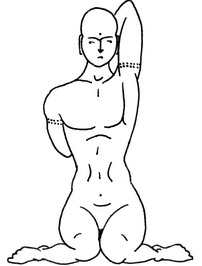
Sit with your buttocks on the floor, the shins and feet on either side of your body.
The feet are perpendicular to the body and shins.
Spread your arms apart, then raise your right hand above your head and lower your left hand down behind your back.
Bend your arms at the elbows and bring them together in a lock behind your back, with the elbow of the raised arm located behind your head.
Keep the spine straight.
On finishing, move your arms apart and switch hands.
This is the normal pattern of cleaning the left and right channels: the left parts of the body are activated first, then the right parts follow.
17. Supta Virasana (Lying Hero Pose)
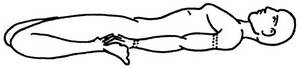
Remaining in the previous pose, lower your arms along the body and lie back on the floor.
18. Pashasana (Loop Pose)
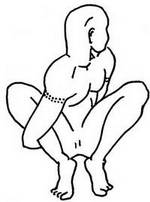
Stand up and squat, keeping your balance on your toes.
Spread your arms apart, then put your right arm under your right knee and your left arm behind the back.
Lock them together behind the back, thus making a loop with your arms.
When finished, switch your hands.
19. Vrikasana (Tree Pose)
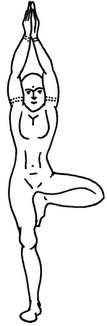
Stand straight.
Put your left foot on the inner side of your right hip, and move your knee as far to the left as possible.
Put your palms together (into the Namaste gesture) and raise them above your head.
Focus your attention on one point to keep balance.
Having done the exercise, switch the legs.
20. Garudasana (pose of the mystical Garuda bird)
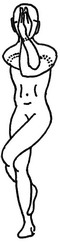
Raise your left leg and slightly crouch down on your right leg.
Place the left leg in front of the right one and wrap it around behind the right leg.
Once in this position, lift up, keeping your spine straight.
Also wrap the arms around each other. Put the right palm on top of the left one.
Having finished this exercise, switch your legs and arms accordingly.
21. Triconasana (Triangle Pose)
Alternative 1
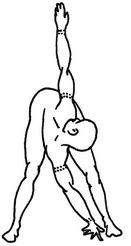
Stand with your feet the shoulder width apart.
Spread your arms apart and, turning to the right, place your left hand on the outside of your right foot.
Move the right hand upwards, with your gaze directed to the right palm.
The body is now twisted.
It is important not to bend the knees in this position.
Hold this position for awhile, then switch to the other side.
Alternative 2
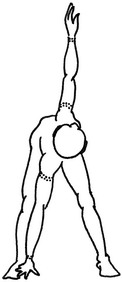
Initial position: as in Alternative 1.
Slowly spread your arms apart and lower your left hand to your left foot without bending your legs at the knees.
Move the right hand upwards.
Look up at the palm of your right hand.
On finishing, slowly rise up.
Perform the same for the other side.
Benefits:
Due to the strong twist, the energy channels in all internal organs and the lower parts of the body are cleaned.
22. Mayurasana (Peacock Pose)
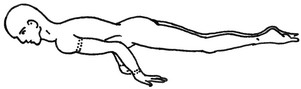
Place your palms on the floor with your fingers pointing backward.
Rest your elbows on your stomach and lift your feet off the floor.
Keep your body horizontal while balancing on your arms.
Freeze for 10-20 seconds.
Benefits: Mayurasana is the best pose for strengthening of the fire element.
Yoga tantras say that those who perform it regularly can actually digest cobra venom.
The strong element of fire builds a base for entering Samadhi.
23. Ardha Dhanurasana (Half Bow Pose)
Alternative 1
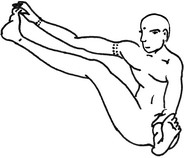
Sit on the floor with your legs stretched forward.
Grab your toes.
Extend your right leg to the right as much as possible, trying to keep it straight.
Hold that position.
Perform the same for the other leg.
Alternative 2
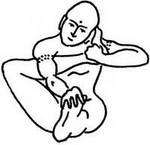
Assume the initial position. Grasp the toes of the left foot with the right hand, and the toes of the right foot with the left hand.
Pull the left foot up to the right ear and hold that position.
Assume the initial position. Switch the hands and repeat the exercise.
Alternative 3
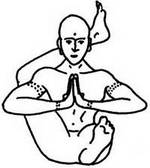
Assume the initial position. Take your right foot and slowly place it behind your head.
Place your hands in front of your chest with the palms held together (Namaste).
Switch the legs.
Benefits: this asana is also called Urdhvaretasana.
It allows to sublimate the sexual energy and raise the semen upward.
To do this is very important, because the seminal fluid is the immortality nectar that has reached the Svadhistana Chakra.
That’s why the sutras say that the yogi who has raised the seed upward acquires the divine body.
24. Jatthara Parivartanasana (Stomach Twisting Pose)

Initial position: lie on your back.
Holding the legs together, lift them up and lower them on the right side to the floor, at the right angle to the body.
The arms are on the floor, spread apart.
Try to hold on to the toes with your right hand without bending your legs at the knees.
Turn your head to the left – the opposite direction with the legs – but do not take your shoulders off the floor.
This way, the body is twisted.
Then lift your legs up and put them to the left.
Do the same for the opposite side.
25. Uttanasana (Boat Pose)
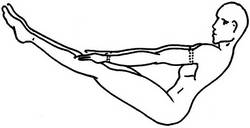
Sit on your buttocks.
Make them the point of support and lift your legs up so that the right angle is formed.
Hold your hands parallel to the floor with the palms down.
Hold this position for 30 seconds.
Benefits: this pose is recommended by God Shiva in the Vigyan Bhairava Tantra to achieve semen control.
In this pose, the muscles are tensed that enable sending the sexual energy and semen upward.
26. The Chakrasana (Wheel Pose)
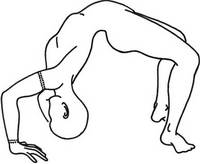
This is a bridge with a head support.
Lying with your back to the floor, lift your body up, pushing the floor with the palms and feet.
Put your head on the floor and hold that position for 1-2 minutes.
27. The Roller
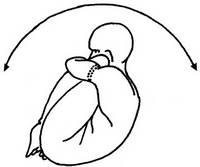
Lying with your back to the floor, press your hips against your chest, wrap your arms around your shins and press your head against your knees.
Rock back and forth and left and right in this position.
28. The Karnapidasana (Ear Pressure Pose)
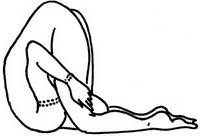
Lying on your back, put your feet behind the head, with the knees covering the ears.
Grab your feet and pull them towards so that your thighs are parallel to the floor.
Hold this position for a few minutes.
Keep the eyes closed.
29. The Halasana (Plow Pose)
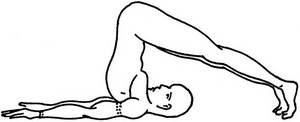
From the Karnapidasana position, straighten your legs and touch the floor with your toes.
Put your hands to the opposite side.
In this pose, do the Ashwini Mudra and visualize how the energy goes up from your coccyx along the spine to the Ajna Chakra.
Pay attention to not bending your knees.
Benefits: this asana rejuvenates the body, prevents the immortality nectar from burning, awakens the Kundalini energy and promotes the opening of the Muladhara Chakra.
30. The Viparita Karani (Inverted Body Pose)
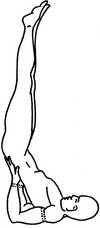
Raise your legs from the Halasana position, supporting the lower back with your hands. Concentrate on the Ajna Chakra, imagining how red flames rise from the coccyx along the spine to the Ajna.
Benefits: Viparita Karani is so called because in this pose the mystical moon at the top of the head and the sun in the Manipura Chakra change places, and the immortality nectar accumulates in the body.
Yoga tantras say that the gray hair and wrinkles of a yogi who performs Viparita Karani will vanish, and those who exercise this mudra for a long time for three hours a day, will conquer death (i.e., enter Samadhi).
This mudra is considered the best for disposing of worldly desires, because the energy channels in the lower body become purified and the energy enters the central channel (Sushumna) and opens the upper Chakras.
When performed together with the Ashwini Mudra, this pose promotes awakening of Kundalini and opening of the Muladhara Chakra.
Start doing Viparita Karani from 5 minutes, bring it up to half an hour or more.
On finishing the asana, put your feet behind your head and slowly (vertebra by vertebra) lower your back and feet to the floor.
The asana complex is complete.
It is recommended that the inverted asanas be always followed by a relaxation meditation in the Shavasana (a lying pose that is used for relaxation).
31. The Shavasana (Lying Pose)

Lie on your back, put the legs apart with the distance between the feet of about 50 cm, put the hands down along your body with the palms up, 10-15 cm off the body.
Relax completely.
To do this, tense the muscles of the face and the middle part of the abdomen, then slacken them. This will relax the whole body well.
In the Shavasana, meditations can be performed in which one has initiations.
Contacts of "Worldwide Sanatana Dharma Community":
Omkar +380684188899 (Telegram, Viber, Whatsapp)