


|
Calendar Veda Loka
2026 THE YEAR OF DHARMA PREACHING
23 October
Friday 2026 year 00:00:00
Time
chronology 5121 years of Kali Yuga,
28th Mahayuga 7th Manvantara The era of Manu Vaivasvata boar Kalpa first day of 51 years of the great First-God-Creator |
||


|
Latest Updates
|
||
|
Video Updates
|
||
«Having realized the senselessness of materialistic values,
we strive for Liberation.
Having realized the value of sadhana, which gives Liberation,
we strive to practice it.»
Swami Vishnudevananda Giri
The method of atma-vichara (self-enquiry) is the most direct path to spiritual self-realization from the very beginning, implying a vision of the ultimate goal of human existence - unity with the Absolute, the highest "Self" (Atman). This method was revealed to the world by Sri Ramana Maharshi. Its goal is to overcome the conditionality of consciousness by the thoughts that arise in it, leading to the exit beyond the boundaries of the feeling of "Self" or "ego" to what is called Liberation.
Atma-vichara – a meditation of finding the inner observer and the false "Self" – is the direct path to awareness. According to Ramana Maharshi, all other meditative techniques lead to atma-vichara, prepare for it, but do not replace it.
Vichara is practiced as an exercise in the traditional meditative posture and as a permanent internal process during any activity. The practice of atma-vichara does not require the knowledge of abstract theories or adherence to a philosophical doctrine or religion and may begin at ground zero. For all those willing to perform the intensive practice of atma-vichara, this publication provides detailed practical guidance on this methodology based on the experience gained at the school of Swami Vishnudevananda Giri.
The book is based on the materials of the Master's lectures.
PART 1
INSTRUCTIONS FOR PREPARING
FOR INTENSIVE SPIRITUAL PRACTICE
Concentration Practice
Before beginning intensive practice (retreat), it is essential to establish the proper work of consciousness. Monasticism is withdrawal from worldly life and renunciation. However, we go not only the way of the monk, renunciation, or Raja Yoga but also the highest path of Sahajayana, Laya Yoga. In the practice of concentration and withdrawal from external reality, you must have an extremely focused consciousness wholly committed to achieving spiritual realization.
We follow the path of the natural state (sahaja), self-liberation, unconditional service for the benefit of all beings (lila), and the principle of the illusory body. It requires the highest level of preparation. And, perhaps, you will feel the effect only after six to eight years of spiritual practice (sadhana). It is the path of attaining Liberation in one life, understanding its highest pinnacle, understanding the nature of the mind, and self-liberation; after experiencing samadhi , one must now lower the bar a little. By becoming aware of our current level and circumstances, we need to understand how we can achieve Liberation by employing more simple practices.
When you start practicing in retreat, I would like you to develop the consciousness of total detachment, the consciousness of Raja Yoga. For you, this is an excellent opportunity to fully concentrate on the practice, be engaged in the spiritual practice around the clock for a long time, and not be distracted by anything. Even if you were involved in performing service (bhakti) or some other things and could not practice well, now you, the Buddha Shakyamuni, and Milarepa have equal chances like this. There is you; there is the lotus pose (padmasana), and in front of you is the eternity. That is all – nothing prevents you! Everything depends only on you. There are no external factors, distractions, or worldly objects. It all depends on how you can deepen your consciousness during this time.
In this retreat, we will pay much attention to concentration practice. Achieving samadhi and Enlightenment through the practice of concentration is effortless. It requires absolute determination and absolute renunciation. We often say that our consciousness creates the world around us, but we often realize the discrepancy between what we say and what we do. Why does this happen? – Because, in fact, we are often unconscious.
For example, I recommended a pool and a sauna to some recent practitioners and something else. Moreover, now their mind starts to work this way: "Oh, how will I practice at the place where there is no sauna... where will we go to the sauna?" Again the mind begins to work, and suffering arises because there is no such possibility anymore. It was, now it is not, and the mind starts to think about how to get it. It’s weird, but when all this was not recommended just a month ago, was there such a process of consciousness? Imperceptibly to themselves, they fell into such an illusion. The mind did not think about it at all or even suspect it. Nevertheless, these things took place – and immediately appeared the restlessness of the mind, a feverish work of consciousness.
You must understand that this happens to everyone and is how conditionality emerges. If there is no experience of the path of Raja Yoga, of complete renunciation, then our practice of self-liberation will not bear fruit. The most convenient way to fully understand the nature of the mind is the path of absolute renunciation. I went through an almost three-year practice of silence and complete solitude, chanting mantras, concentration, and meditation. Due to this practice of concentration, great willpower was developed that allowed me to perform self-enquiry (atma-vichara), concentrating on "I-thought" (aham-vrtti)without being distracted for eight to fifteen hours a day.
Dharana
Now let us talk about concentration (dharana). Try to understand it well; this is a practice you will carry out in the retreat.
Even though we are performing the practice of self-liberation, often thoughts and feelings take over us. The Atman is not accessible at this surface level, where our thoughts move.
In fact, why do we suffer? Why do we not realize our Higher Self? If we imagine our consciousness as some sphere, our true self-awareness (Atman) is its center. The beam of its attention is directed to the periphery. This ray moves on the plane of the superficial consciousness. It slightly goes through the superficial consciousness to objects and enters the subconscious slightly. It is our existence in the World of Phenomena. Here is our meditation and self-liberation. The ray of our consciousness illuminates only this narrow range. Superficial consciousness is our thoughts. Thoughts move from birth to death in an unceasing flow.
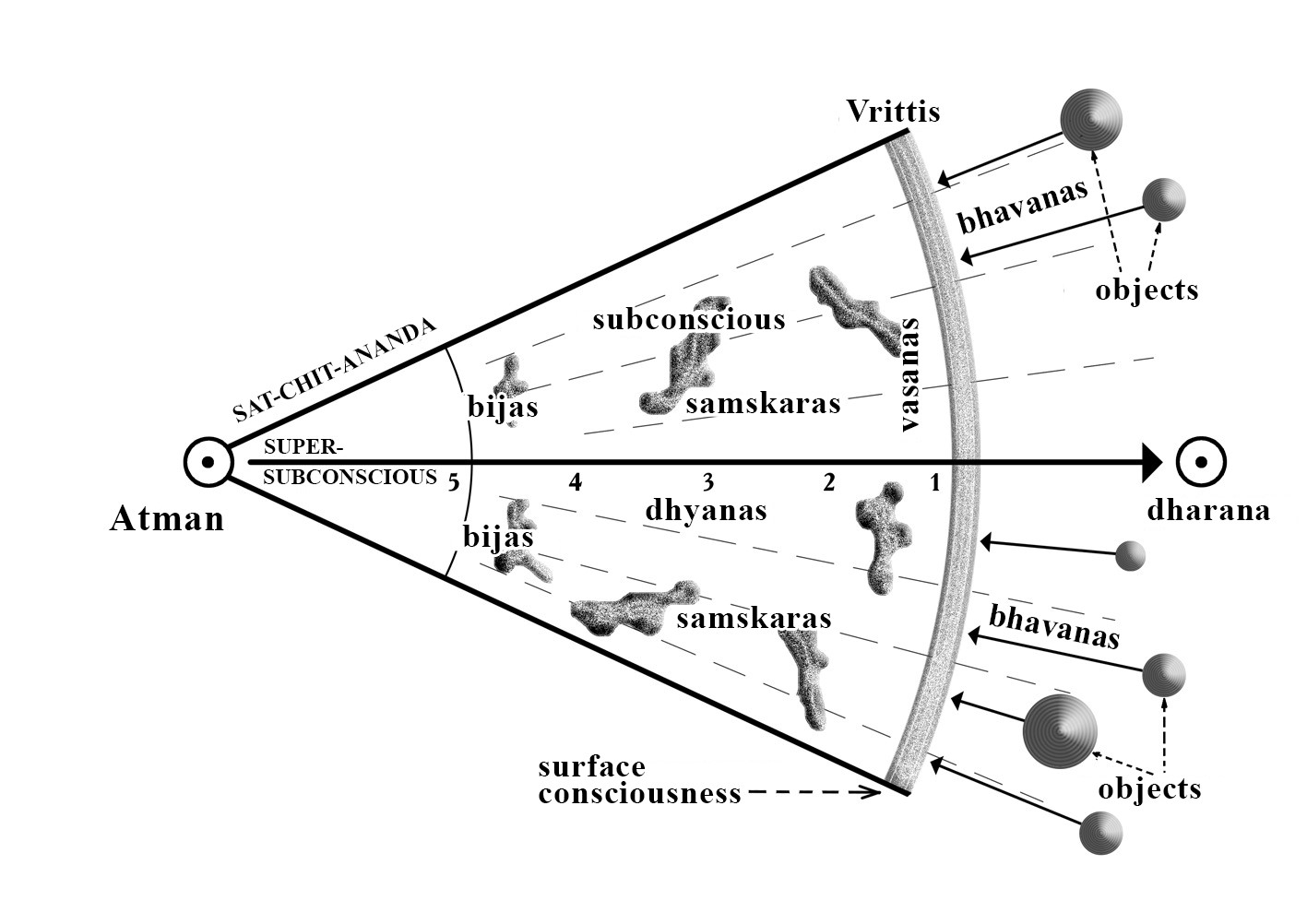
Pic.1
It is not just thoughts – every thought carries energy (bhavana). Thoughts contain energy. The essence of samsara is that you are constantly in this stream of thoughts.
Imagine now the first thing that comes to your mind.
– An armchair…
An armchair is a material object, even if it is very beautiful. An armchair causes certain associations (bhavanas) in our minds. Bhavana is an impression. An armchair is associated with something hard or heavy, and the corresponding bhavana is generated by the thought of an armchair; at that moment, when we think about it, for a while, the astral body moves into a state of something dense and heavy. It is how bhavana is created due to some thought.
The next thing you might think about?
–The Teacher…
It is also a certain bhavana, depending on how you perceive the Teacher. If you perceive the Teacher as the embodiment of the Divine (Bhagavan), then bhavana of Bhagavan arises, and you are merged back into the deep inner self-center. If you perceive him as a body, there is a bhavana of the body and something else.
Thoughts constantly move from birth to death twenty-four hours a day, except when we enter the World Without Forms – during a dreamless sleep. It is the state of sushupti.
When bhavana appears, our astral body, in accordance with this bhavana, enters the world of this energy. As a result, we constantly fall into the state of gross identification, into states of the gross (material) world.
Imagine that thoughts move like an impersonal stream, like a mechanical mass. They are like trains, and they have no essence of their own. Nevertheless, we consider them to be something real, something absolute, and we are greatly deceived. When you understand this process of identifying with bhavana, you will be horrified by the state in which the conditioned soul exists! It is what deceives all people in samsara. However, the fact is that all the thoughts have absolutely no essence. They arise arbitrarily and leave arbitrarily. It is a bluff that is revealed only when you can block them, only when you can observe them.
Thoughts move across the screen of our consciousness: one comes, another goes. In their footsteps arises bhavana. Bhavana gives a certain vision and attitude. Perhaps you have noticed that if you come to your grandmother or other relatives, your parents, sometimes there is such an aching feeling in your chest, a feeling of affection, but at the same time stiffness and an impulse to leave. It is the bhavanaof the World of People. If you enter a temple there is another, spiritual energy – the energy of practice, holiness, the way of salvation. If you communicate with someone who has attained spiritual realization, there appears such a light, easy, playful feeling, a feeling of irreality. It is the bhavana of those who have attained it.
Our consciousness, through thoughts, through bhavanas, makes contact with external objects, and, in turn, external objects make contact with our consciousness. Imagine that our consciousness is constantly bombarded by bhavanas, and therefore suffering exists. In samsara , there is always suffering because consciousness is vacillating. Thoughts cause bhavanas. Bhavanas are beating on consciousness. When bhavanas are beating on consciousness, the consciousness feels unstable; it constantly rises, then is thrown back down. Everything depends on bhavanas, and bhavanasdepend on thoughts.
Ordinary people's thoughts arise chaotically and spontaneously, and then experience various sufferings. An entire lifetime of an ordinary person takes place on this periphery. Of course, he has a deep state of subconsciousness and consciousness, but he is unaware of it. He has a superconsciousness, the state of Atman, but he is also unaware of this. Because thoughts flow as a continuous stream and consciousness stays in this outer layer, a person feels alienated and separated from the highest spiritual reality (Atman).
When contact with objects occurs through this outer layer – the superficial consciousness – the objects seem foreign. These objects are not considered a part of one's consciousness; they seem solid, external, having their own existence. Naturally, the illusion of yourself appears as a separate personality, independent from objects. Then, the person in this superficial layer of thoughts and bhavanas is established in a separate, independent existence. This personality lives from birth to death in this layer of superficial consciousness. It rises and falls, experiencing various sufferings at the level of consciousness, different bhavanas. The body, its awareness, is also located here. All our fixed ideas, including ideas about the path of spiritual evolution (Dharma), including our practice, are located in the superficial consciousness, except the experiences of samadhi and self-liberation.
When a person dies, this entire layer is simply cut off. A person, together with the body, with all his consciousness disappears, but samskaras - imprints in consciousness - will remain. The samskaras will project another subtle body, which will be an illusory body in the intermediate state during rebirth. However, because it is not developed and does not have stable bhavanas, it will chaotically flail around, depending on the dominant karmic winds, pranas, and samskaras . Then, it will be drawn into the superconscious, and then come out again until rebirth occurs.
Pure Light is the essence of all objects. Light is located in anahata-chakra . Via a subtle energy channel, light emerges from the heart and is projected outside through the eyes. Projecting through the eyes outwards, it decomposes into a spectrum of five colors, and then we see what we see - the World of Samsara, consisting of different objects: houses, people, clouds, and trees. And then we fall into illusion.
What does the practice of concentration or the practice of Raja Yoga mean?
We must break through this surface layer of consciousness. Imagine that you are starting the spiritual practice, concentrating, and performing dharana. This sphere, which personifies our consciousness, becomes unidirectional. Then the whole flow of thoughts that moves at the periphery is blocked. The stream of thoughts is interrupted, and your consciousness is still for the first time. There are no thoughts. If there are no thoughts, then no bhavanas are generated – for the first time, you are without illusions. When bhavana is generated, you send your subtle body to the place of these thoughts, to the place of samskaras. As soon as you think about home, about another person, about salvation, about heaven, about bad worlds, your subtle body immediately goes there a little. However, when you practice concentration, all thoughts are blocked. When your consciousness is at this level, it is a state of approaching concentration. It is a very unstable state.
Here is how it is described in the text "The Variety of Meditative Experience," where Daniel Goleman, the author, outlines the traditional meditation manual called "Vishuddhi-marga," created in the fifth century AD by the monk Buddhagosha.
Interfering thoughts are overcome, but other thoughts remain. There is an awareness of sensory perceptions and one's body. Thoughts about the main object of concentration prevail – the feeling of delight, happiness, and balance. Once they emerge, thoughts about the main object of concentration are sustainably maintained – flashes of light or bodily lightness.
Daniel Goleman's "The Variety of Meditative Experience"
When you practice concentration, a layer of superficial consciousness is overcome, and gradually your subconscious mind begins to come to the foreground. It is easy to obtain the mystical experience, samadhi, the experiences of the subconscious through the practice of concentration. This world is very illusory. If you stop thinking and get to this stage, you will discover it will begin to disappear slowly. You will discover the whole mystery of the origin of samsaraand the appearance of illusion.
In concentration (dharana), there are many stages. Concentration, in general, can be of different levels:
1) Sthula-dharana is the concentration on the objects of the material world.
2) Sukshma-dharana is the subtle concentration, for example, on the chakras.
3) Shunya-dharana is the concentration on emptiness, a consistent concentration on the four types of the emptiness of the World Without Forms.
4) Atma-dharana is the highest practice of concentration, but it is not a dharana, but being in a natural state of mind.
In this way, your subconsciousness emerges, and you experience the most profound changes in your consciousness.
Stages Of Concentration
First Dhyana
With a continuous, uninterrupted focus on the object of concentration comes a moment that marks the first complete break from ordinary consciousness. It is complete absorption, dissolution – Dhyana. The mind suddenly is immersed in the object and remains motionless in it, and the distracting thoughts disappear entirely. There are no perceptions through the sensory organs nor the usual awareness of one's body; physical pain is not felt. Delight, bliss, and one-pointedness predominate in the mind; these are the mental factors that, when simultaneously manifested, are signs of the state of Dhyana.
Daniel Goleman's "The Variety of Meditative Experience"
First, for a certain period, your mind sticks to the point – the object of concentration – and then it loses it because the usual tendencies of consciousness prevail. Then you hold the object of concentration again for a while, then lose it again. However, why do you lose it? After all, you must sit down and enter into samadhi exactly after thirty-two minutes. However, when you practice meditation or concentration, you constantly lose it. As a result, meditation grows into this continuous struggle. For most of you, I would not recommend the meditation of emptiness and atma-vichara at this time. If you want to advance your consciousness fast, practice concentration in a retreat; I recommend it. The practice of concentration gives a tangible increase in consciousness in a short time.
In India, there are yogiswho, having forgotten the world, were immersed in samadhi, and birds had built nests on their heads. Alternatively, they would clasp their hands, and nails would start growing from the other side of the wrist. The Rishis practiced Raja Yoga, which was very popular in Ancient India. They practiced concentration and could perform various miracles of asceticism, attain siddhis, and prolonged samadhithrough the concentration.
Therefore, when you block thoughts, your superficial consciousness is opened, and subconsciousness emerges. One more layer is added to the consciousness, and you accurately perceive the object of concentration. Finally, when you can overcome all the distracting thoughts, your consciousness "sticks" to the point. It holds the point, without leaving it, not being distracted. It is as if something subtle will flow out of you and as if you will swallow this point almost tangibly. You need to note how long you can do it. If you have more than twelve seconds you can congratulate yourself: this is the state of dharana, concentration, the sixth step of Raja Yoga. When you could concentrate twelve times for twelve seconds this would be the real meditation. Finally, when you can hold twelve times for one hundred and forty-four seconds (about twenty-eight minutes), you can enter into one of the samadhis, for example, the samadhi of the first or second dhyana. At this time, because your thoughts are blocked, you experience ecstasy and bliss.
There is a subtle difference between ecstasy and bliss. Delight at the level of the first Dhyana is like the first experienced pleasure or excitement when you receive a long-desired object; bliss - is the possession of this object. Delight can be felt as an instant joy, flashing and disappearing like lightning, like a wave rolling over and over again, when the hair rises on the body, as a feeling of loss of body weight, or as an immersion in the whirlpool of happiness. Bliss is a more relaxed state of prolonged ecstasy.
One-pointedness is that feature of the mind that focuses on the state of Dhyana. The first acquaintance with Dhyana lasts only for a moment, but due to continuous effort, gradually appears the ability to maintain this state for longer and longer periods.
Daniel Goleman's "The Variety of Meditative Experience"
When your one-pointedness increases, you can gain deeper layers of consciousness. Accordingly, you can capture samskaras, which lie more deeply. At this time, you have a more exalted type of bliss. You begin to see the point with the eyes of the deeper layers of consciousness, with the eyes of the second dhyana. This state is achieved due to narrowing your mind due to concentration.
Second Dhyana
During the concentration, one-pointedness becomes more intense by eliminating the factors disturbing Dhyana.
Daniel Goleman's "The Variety of Meditative Experience"
When you are in a state of delight or bliss, you must let them go one after another and consider them meaningless.
The most valuable of these states is one-pointedness. One-pointedness is a state in which the mind is continuously focused on the object of its concentration.
Further, increasing the intensity of one-pointedness after reaching the first Dhyana requires eliminating both the initial and repeated return of attention to the object of concentration.
Daniel Goleman's "The Variety of Meditative Experience"
Before that, your consciousness could both increase and decrease the attention to the object. Now, one-pointedness has intensified. It means that your mind maintains attention on the object of concentration for a long time without interruption. The sutras describe it as a continuously pouring stream of oil. That is how your unidirectional consciousness should be.
"A practitioner enters the first Dhyana by focusing on the main object of concentration. However, then he releases his mind from all thoughts about this object and turns his mind to ecstasy, bliss, and one-pointedness. Now the practitioner's mind is entirely free from all thoughts that could be expressed in words and even thoughts about the main object of concentration. Only the reflected image of this object, as the focus of one-pointedness, remains.
Daniel Goleman's "The Variety of Meditative Experience"
The achievement of even the first dhyana is a great thing. It is said that the yogi, who has attained the first dhyana, will be reborn in the heavens of Brahma thecreator. These are the Holy Heavens of the Lower Level.
Third Dhyana
In the third dhyana, feelings of bliss and delight disappear.
The meditator masters the second Dhyana exactly as he mastered the first to go even deeper. Then, after going beyond the limits of the second Dhyana, he realizes that delight – a form of excitement – is more coarse than bliss and one-pointedness. Then he contemplates the main object of concentration again, and at first leaves the thoughts about the object and then about the ecstasy, so he reaches the third level of Dhyana.
Daniel Goleman's "The Variety of Meditative Experience"
When you concentrate, you will feel that your consciousness becomes short. Imagine that during concentration, your consciousness is a ray that emerges and grabs the object of concentration. Its length, created by the power of differentiation, is a superficial consciousness. In the process of meditation, this ray of consciousness is shortened, and the shorter it becomes, the closer you come to your Higher Self. It is shortened due to the ceaseless contemplation and concentration on the object.
At the third level of dissolution, there is an equanimity even in relation to the highest delight.
Daniel Goleman's "The Variety of Meditative Experience"
In the third dhyana, you feel that you and your whole life are at this point in the entire universe, all three worlds of samsara. At a very subtle level, you are so identified with the object of concentration that you sometimes cannot tell where the point is and where you are. There are practices, for example, concentration on a candle, when you need to reach such a level of concentration that you can see your physical body from the position of the candle. In other words, you concentrate, then look at yourself, sitting opposite the one concentrating on a candle. It means the astral body comes out during samadhiand can contemplate the physical body. It could be achieved approximately on the second-third dhyana.
This Dhyana is very subtle, and without this newly emerging equanimity, the mind would be thrown back to delight. If he remains on this third level of Dhyana, an extremely pleasant feeling of bliss overwhelms the meditator and spreads throughout his body. Because at this level bliss is accompanied by equanimity the practitioner's mind is directed only towards the one thing: these subtle aspects of Dhyana. It does not roll back to the grossness of delight. Mastering the third Dhyana, just as he did with the previous ones, the practitioner can move on if he is convinced that bliss is more restless than one-pointedness and equanimity.
Daniel Goleman's "The Variety of Meditative Experience"
At this level, you see that bliss and delight are gross states, and you desire to maintain only a state of one-pointedness and equanimity. Equanimity is such a subtle state of detachment that you want nothing but to stay in. Samadhi begins on the third dhyana. You must take care of your pose between the third and the fourth dhyanas. If you change your legs often or at the moment of the deep third dhyana, you change your legs, and you cannot attain samadhi. On the contrary, a fixed posture is a condition where you can often experience samadhi. You could stop breathing and will not feel the heart beating, or the heartbeat will be very slow.
It is said that Buddha Shakyamuni recommended to his disciples to walk a lot because in dhyana, they consumed very little oxygen, and their metabolism processes were not the same as in ordinary people.
Fourth Dhyana
To penetrate even deeper, the practitioner must leave all forms of mental pleasure. He must give up all those mental states that can prevent complete tranquility, even from bliss and delight. With the complete cessation of bliss, one-pointedness and equanimity gain full strength. In the fourth Dhyana, the feeling of bodily pleasure is completely abandoned; the feeling of physical pain disappears as far back as the first Dhyana. There is not a single sensation, not a single thought.
Daniel Goleman's "The Variety of Meditative Experience"
At this level, not only thoughts but all your sensations also disappear. The fourth dhyana is a profound state that is very difficult to express. It is the level of subtle consciousness.
During the third or fourth dhyana, you may have flashes of clarity. The insight of your consciousness becomes incomprehensible. It is the consciousness of the Gods of the Heavenly Realms. At this level appears a great temptation. You can receive insights one after the other. You suddenly understand the structure of attainment, or universal thoughts of salvation appear. These insights may shock you with their clarity, and you may succumb to them and lose your third-fourth dhyana state and start thinking. Do not do this by any means! However, if those epiphanies do not give you peace, take your time, write them down on paper to think about later, and continue concentrating. These can be profound insights about everything.
At this fourth level, the breathing is so calm that he cannot feel a single movement.
Daniel Goleman's "The Variety of Meditative Experience"
Dhyana Of The World Without Forms
The next step in concentration, the culmination of the four previous Dhyanas, is called formless. The first four Dhyanas were reached by concentrating on a material form or some concept received from the previous concentration. However, the practitioner attains formless states by going beyond the perceptions of every form. In order to enter the first four Dhyanas, the meditator had to empty his mind of mental factors. To enter into each of the following formless Dhyanas, the practitioner, one by one, replaces the objects of concentration with more subtle ones. In all formless Dhyanas, there are mental factors of one-pointedness and balance, but at each new level, these factors become more and more subtle. It is how concentration becomes indestructible. Nothing can take the practitioner out of it, but after a certain period of time determined by himself, he comes out of it, returning to the same state in which he was before entering it.
Daniel Goleman's "The Variety of Meditative Experience"
When you reach the state of the fourth dhyana, you lose the attachment to form. The object of concentration is no longer that important, and it serves simply to focus your consciousness. Your superconsciousness begins to open. At this level, you may have an aversion to external objects. The name and form (nama and rupa) can be denied. Everything that has a name and form becomes highly unpleasant. You do not want to listen to music or see yourself or others in form because the mind is in an indescribable formless state. You may have dreams where you see a formless dome of the sky above you, or samskaras may pop up when you look at the ocean or a vast expanse.
When you strengthen your dhyana one after the other, you go through four levels of the World Without Forms. We will not describe these states in detail; practically speaking, these are the levels of attainment in Raja Yoga. Then, one after the other, we experience the states of infinite space, infinite consciousness, and emptiness, strengthening our consciousness. Finally, after going through these four levels, you experience an incomparable state of Atman. This state is of the seventh-eighth dhyana. When you reach a state of deep awareness, there are no thoughts, therefore, no bhavanas. You see the world from the highest point. Your consciousness, through concentration, has gone this way from the periphery to the state of the Higher Self. In the process of concentration, it annihilates all the samskaras.
For example, you take a board and a drill and start drilling. You go through different layers and reach the very heart of this board. Your consciousness is a board, and your concentration is a drill. When you get to Atman, all your conditioning is lost. You stop perceiving the world in the old way, which is called attaining the state of Liberation and Enlightenment.
Are there any questions?
– Why does the dot (point) begin to glow and change during concentration?
It is part of your clarity. The subconscious begins to manifest itself. The sensation of light and various effects occur at the level between the first and the third dhyana. It is normal. It is neither bad nor good – it is a sign of progress.
Conversely, when you concentrate on the flame, the flame begins to appear dark in the center. Alternatively, a small flame begins to appear inside, and then the flame starts to take on the colors of the various elements. You can have visions of deities, of the chosen deity (ishta-devata). However, you need to consider all this as a hindrance during concentration.
– Could addiction to this state arise?
It will arise if you do not have a higher doctrine than Raja Yoga; that is what I think. If you do not follow the principle of self-liberation, then it will inevitably arise.
What is happening? The meditator has just broken through such a tunnel in his mind. He’s got to the true consciousness, but he could walk only through this tunnel. However, look: bijis, vasanas, and samskaras are not destroyed. He can feel himself as Atman only when he walks through this tunnel and concentrates. As soon as he goes beyond the tunnel – everything is blown away – he loses everything. Therefore, Raja yogis are recommended to sit for the rest of their lives and concentrate, and if they go out somewhere the years of meditation in three days will be wasted, and they will lose everything. Suppose the practitioner does not have higher teachings such as Kundalini Yoga and Laya Yoga, Sahajayana, and the principle of self-liberation. In that case, he is very weak and dependent on the object of concentration. He needs to hide himself all his life not to lose the dhyana.
These experiences of concentration are needed to deepen the consciousness, to understand this consciousness, which is beyond all worldly conditioning through feelings, mind, and the body, and to experience the highest states of consciousness. However, a practitioner of the highest yogamay return from these states to the surface consciousness and even have thoughts. Since he has now understood their emptiness and their illusory nature, they no longer have a hold on him. Moreover, this way is preferable. Practicing the yoga of the illusory body and self-liberation, being at this level, he begins to expand a corridor drilled by concentration, and this is already a segment of consciousness. If self-liberation is practiced, even when thoughts appear, bhavanas do not arise because he constantly contemplates his superconsciousness. Imagine, thoughts appear, but bhavanasdo not arise. The astral body is directed all the time toward superconsciousness. Will objects have an effect? No! Will there be an illusion? No! Even if you are in the superficial consciousness, you allow thoughts, then bhavanais entirely different – there is a connection between the subconscious and the superconscious. As the thoughts stop, for example, in a dreamless sleep, consciousness deepens, and light and infinite consciousness, superconsciousness, is experienced. Moreover, when the surface layer of conceptual thinking erases in the intermediate state between a death and a new birth, consciousness naturally unites with superconsciousness and realizes the primordial Clear Light.
– During meditation, I often see a corridor, a tunnel, and at the end of it – the light...
No, the tunnel in mind is just a diagram; you should not visually see it...
– The first time, it appeared during the direct introduction, when there was a gap between thoughts: the corridor and the light at the end. Furthermore, after, when I meditated, this corridor expanded.
What do you think if you look at the world through the eyes of the third dhyana when there are no thoughts and no discriminating consciousness? What will you see? If it's time to supervise meal preparation (prasadam), and you look at the world through the eyes of a child - you do not see any food, anything... That the vegetables and the column are all the same. What do you call it?
– No, you understand everything; you see and cognize everything…
It is a good, advanced state from the point of view of a Raja yogi. The only thing is that at any moment, you need to be able to direct your consciousness to the necessary point - outward or inward. The practitioner of Laya Yoga does not depend on concentration. He does not have a fixed point in his consciousness. Depending on the situation, he may withdraw extremely into superconsciousness or superficial consciousness, even allowing for discernment and thoughts. However, for all that, this is not a real discernment, it is the practice of play, of the illusory body.
– But the transparent light at the end of the tunnel?
The experience of different kinds of light exists in the second-third dhyana. Then, when we go deep, we see three fundamental lights located in superconsciousness. In order to see the three fundamental lights, you must concentrate for a long time. They cannot appear spontaneously like this – these are very deep kinds of light. In practice, you need five hours of samadhi in padmasana to get into the superconscious.
– At first, a whirlpool of dark light, and then transparent lights appear ...
It likely refers to the three types of light in the subconscious. Experiencing these three kinds of light as often as possible and then immersing yourself in the primordial Clear Light of the Higher Self is a practice that must be made to bring this into a dreamless sleep. In essence, this is the attainment of realization. It is a very high level; only a few people can experience it.
– What if you make everything the point for the concentration?
If you make everything the point, you will not have a corridor but a segment or sphere. However, this is the next practice when concentrating on atma-vichara, – and then on the nature of the mind. It is the next step, and you must make everything the point of concentration. How, in essence, is the path of Raja Yogadifferent from the path of Laya Yoga ? The Raja yogi concentrates on the point, and through this, the Atman is revealed. Laya yogi concentrates on everything manifested, as on his own consciousness, and reaches such an intense consciousness. However, it is impossible to do this at the beginning of practice.
Even if you reach the first dhyanawith all of this, you can attain Liberation in an intermediate state during rebirth. Consciousness will be gradually drawn in and overcome layer by layer until it reaches the primordial light. In other words, one who has mastered self-liberation has mastered a very powerful tool. However, it is necessary to understand it on a deep level. Even if you, while practicing the illusory body and self-liberation, are in the surface consciousness, you can attain Liberation during rebirth because integration with deeper layers of consciousness will occur.
– Continuous control of the mind and its self-liberation – how does this relate to the dhyanas?
In essence, self-liberation for us is to be aware of the nature of the mind (prajna). It is no longer a concentration (dhyana). That is to say; dhyana is present when there is a narrowed consciousness. Prajna is not narrowed but, on the contrary, an unfixed consciousness. However, the principles of experiences that arise are similar: joy, clarity, and non-duality. When you concentrate on the "I"-feeling (aham-vritti) this is subtle concentration (sukshma-dhyana). Aham-vritti plays the role of the point. However, why is it so difficult to concentrate in atma-vichara on aham-vritti? – Because there is no such consciousness powerful enough to take up aham-vritti and reach the eighth dhyana. So you need to start with concentration on the point/dot. Having attained great concentration on the point, you can easily hold on to aham-vritti for a long time and enter samadhi.
– A practicing laywoman who succeeded in concentration said she had a problem: her mind was as if sticking to the surrounding objects.
It is the main problem of practitioners of Raja Yoga. In fact, she made a mistake. As a laywoman, she performed practices that contradicted her status. Imagine: a person practices Raja Yoga in their apartment. Their consciousness sticks to everything due to concentration. However, they goes outside, and cars, shops, products, anything takes his mind away. They cannot get out of this. For Raja Yoga, renunciation is necessary, a condition in which one can concentrate all their life. If you do not possess Higher Teachings or self-liberation to control your mind, the whole practice will end at this stage.
Concentration is the easiest way to obtain experiences for changing consciousness. Self-liberation is the highest path. You have received this true understanding, and now you need to be engaged in deepening your consciousness with such practice of concentration.
For example, a person does not know how to swim and comes to a coach, and the coach says: "You jump into the water and stay there; it will carry you on its own!" The better coach would say: "Row with your right hand, then the left one, and now with your legs!" – This coach is better. We need to start with a gradual method.
– Which dhyana arises from a direct introduction to the nature of the mind?
No, there is no concentration here. Direct introduction touches a layer of surface consciousness, the mind. We begin to analyze it; we self-liberate thoughts. What does this mean? Thoughts stop giving bhavana. They become unimportant. The process of thinking somehow breaks down and also becomes unimportant. It concerns neither the point nor the corridor but the whole circle. Imagine the whole circle's periphery begins breaking up. Now, if this is a toroid, and its outer layer breaks, what remains inside it? Emptiness, a hole! Therefore, after direct introduction, most are slightly shocked, as if they were hit on the head. They are thrown back into the subconscious or to the highest "Self", but they do not yet exist in the subconsciousness; they have not yet self-identified there. It affects the very essence of a human. Bypassing all doctrines and theories, the surface consciousness of a person breaks; he is thrown into the subconscious. He cannot deny it because he feels it as something higher and very deep.
It can be done through different types of consciousness. There is bhava-samadhi. It is a low-level samadhi. Practicing union through contemplating spiritual chants and images of deities (bhajan-mandala), chanting holy names, praying, and concentrating on joy, you can reach the third dhyana. To reach a higher dhyana is more complicated. Bhava-samadhi is the formation of a strong discernment in relation to the object of your meditation. Then it completely takes you over. It is said that bhaktas often experience trembling in the voice, hair rising on the body, and ecstasy. What is it? It is the first or second dhyana! You can get to the third dhyana. At this level, you can have intense experiences of clarity. Anyone who understands direct experience at this level can feel the unity with the Absolute – "Aham Brahmasmi" – non-duality.
– Is it possible to concentrate not on the object but on space?
It is not a concentration; this is integration! It is the next stage. Concentration is performed precisely on the object. Everything is achieved by narrowing the consciousness; you make it very narrow. The world for you is reduced to a dot, and everything works out quickly. There are practices when concentration takes place on some object inside during visualization.
Some practitioners attain the state of the seventh dhyana,from about half a year to one and a half years in retreat. However, you can achieve it faster if you diligently practice concentration on a point. For example, you can reach the state of the third dhyana in a month and a half, the fourth dhyana in two months of concentration. Therefore, I think there could be practitioners who will reach the fifth dhyanain three months.
When you go through different experiences, you should open a manual on Raja Yoga and search and compare your experiences with this map of consciousness. The process is straightforward: you concentrate, get experiences, and then see what kind of dhyana you have reached. When you cross the eighth dhyana, you have attained the state of Enlightenment. It is all very simple: you need to sit and concentrate!
– Accordingly, the deeper the dhyana, the more profound karma is manifested.
It is believed that those who have reached the level of an arhat or Buddhahood – a very high level – not through awareness (prajna) but through concentration (dhyana) can live in this world for an arbitrarily long time, up to several kalpas. What are they doing? It is called the path of the fourth dhyana. They enter the fourth dhyana, where there are samskaras related to life and death; block these samskarasand bring in other information, such as health and longevity. By blocking these samskarasat the level of the fourth dhyana, they can remain in this world as long as they like.
When Buddha Shakyamuni was going to enter nirvana, he asked his disciple Ananda: "By the power of the fourth dhyana, I can stop samskarasand stay here as long as I want, or I can leave. I do not care". However, Ananda said: "Well, the teaching has spread anyway, so you can leave peacefully." Buddha Shakyamuni said so three times! Ananda answered so three times. Finally, on the fourth time, Ananda understood something and asked to stay, but Buddha Shakyamuni had already let go of his dhyana and allowed this karma to manifest.
– Is reciting prayers and resolutions also concentration?
Through them, you create a strong discernment concerning certain samskaras, and due to the distinction, you create certain samskaras that become your new karma. After all, everything is a manifestation of this karma, and what you bring into your consciousness will begin to manifest. It is the key to changing your destiny.
You intensely imagine yourself sitting in padmasana, emanating light beams in nirvikalpa-samadhi. You pray about it. After a while, everything turns out in such a way that you take precisely that position.
You pray about dream yoga, intensely imagine yourself as a Siddha-yogi who has achieved in dream yoga. After a while, the energy is attracted, the appropriate samskaras are created, and you get the experience of dream yoga.
Through intense discrimination, samskarasare created through prayers, which pass into the subconscious, and you get what you ask for. The question is, how concentrated are you in doing this?
For example, you cannot experience samadhi. A year passes, another, the third, but the samadhiof light does not come. However, if you go into retreat, and in retreat, you will not practice so much meditation but the directing of consciousness, then suddenly samadhi will begin to happen for you.
Contacts of "Worldwide Sanatana Dharma Community":
Omkar +380684188899 (Telegram, Viber, Whatsapp)