


|
Calendar Veda Loka
2026 THE YEAR OF DHARMA PREACHING
17 October
Saturday 2026 year 00:00:00
Time
chronology 5121 years of Kali Yuga,
28th Mahayuga 7th Manvantara The era of Manu Vaivasvata boar Kalpa first day of 51 years of the great First-God-Creator |
||


|
Latest Updates
|
||
|
Video Updates
|
||
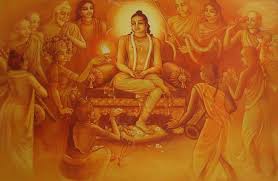
Shuka (Shukadeva) is a great saintly sage, a Siddha Jnyani, known from the Puranas (sacred scriptures of Hinduism), where he is described as the famous son and disciple of Rishi Vyasa. Vyasa narrated to Shuka Mahabharata, and later, the Bhagavata Purana.
As early as a child, Shukadeva thoroughly studied the Vedic texts passed to him by his father. It is believed that Vyasa wrote Bharata Samhita which consists of 24 thousand verses, and passed it on too to his son Shukadeva.
A great advaitist Sri Gaudapada, the author of the famous Mandukya Karika, was a Shukadeva's disciple.
According to some sources, Shukadeva was born by Vyasa's wife, while others say that he was born from Vyasa's semen without the involvement of a woman.
Sources say that Shukadeva was born in a part of the world called Kimpurusha Varsha, or the Himalayan provinces (Hiyamavati), and later he came to Bharata Varsha (India) via the Himalayan countries.
According to the Brahmavaivarta Purana, Shukadeva was a liberated soul (Nitya Siddha, Siddha Purusha, Jivanmukta) even before his birth.
Vyasadeva had narrated the Bhagavata Purana to his son before he was born, and after Shuka’s birth, the child began to study this great work and grasped its meaning.
The Puranas also tell us that Shukadeva surpassed his father in his comprehension of the Absolute. When Vyasa and Shukadeva, walking along a forest path, came upon a group of naked girls bathing in a pond, Shukadeva was so immersed in awareness and contemplation, pure and free from lust, that the girls made no attempt to cover their nudity at the sight of him. But at the sight of Vyasa, they hid at once. And this is despite the fact that Shukadeva was a youth and walked completely naked as naga babas (naked ascetics) do, being indifferent to social norms and regulations, while Vyasa was a profoundly old man.
Later Shukadeva left his father's house to renounce from the world and adopt Purna Sannyasa.
After that, Shukadeva roamed as an Avadhuta – an unmindful wanderer, whose high realization level was unrecognized by the common people. It was only recognized at the times when he was giving talks about the Dharma.
Like the other great rishis and munis of the time, Shukadeva lived on milk alone. He would come to a householder while the man was milking his cow, and take some milk for his sustenance. He did not stop by people's houses for more than five minutes – the time necessary to milk a cow and give the milk to the poor wandering ascetic. Sri Shukadeva Swami was a saint, a great sage, and therefore he was never refused: back in those days, it was a householder’s duty to treat saints like his own children.
Shukadeva was a sadhu capable of explaining the Way of Liberation (Moksha) and telling about the transcendental acts of God.
According to the Vaishnava Bhagavata Purana, Shukadeva was at first a monist. He became a devotee of Krishna only later, when he felt drawn to the spiritual games of the personal God. Other sources say that along with the Bhakti Yoga, he professed pure non-dual monism (Advaita Vedanta), which he had adopted from his father Vyasa, the author of the entirely monistic Vedanta Sutra, dedicated to the non-dual Brahman.
Shukadeva Gosvami narrated the Bhagavata Purana and the teaching of Moksha ( liberation, surrendering to the Absolute) to King Parikshit Maharaj, when the king, upon learning about his approaching death, went to the banks of the Ganges to prepare for it. At that time Shukadeva was on the road, traveling from one place to another. He was only sixteen years old. He came to the bank of the Ganges at the very moment Parikshit was being there, preparing for his upcoming death, surrounded by saints and great sages. During seven days preceeding Parikshit's death, Shukadeva answered a great number of questions from the king. Bhagavata Purana is made up of Parikshit's questions and Shukadeva's answers.
Shukadeva Gosvami belongs to the great saints who are close to God – as close as Brahma, Shiva, or Sanatana. As his disciple Suta says, Shukadeva is a great sage who can get into everyone's heart, and is a guru of all sages.
 YOGA VASISHTHA ON SAINT SHUKA
"Vishvamitra said:
Listen, o Rama. I shall duty narrate to you this soul-uplifting story of the born-sage Shuka, the son of Vedavyasa, who is now seated next to your father. Like you, he reflected on the vanity of worldly affairs and became equally indifferent to all its concerns. Having obtained the highest truth, he was still unsettled in his mind, and could not trust his own knowledge. His mind grew indifferent to its perceptions of the transitory enjoyments of the world. One day Shuka approached his father, Vedavyasa, and asked him: “Tell me, O sage, where does this commotion of the world arise, and how can it subside? What is its cause, how far does it extend, and where is its end?”
Sage Vyasa explained to him clearly all that was to be said, but Shuka thought that he already knew all this by his good understanding and therefore did not think much of his father’s instructions. Vyasa, understanding the thoughts of his son, replied that he himself knew no better than his son about the true nature of these things, but there was a king in this land named Janaka who well knew the knowledge of the knowable, and from whom Shuka could learn everything.
Shuka thereupon came to Janaka's palace.
Informed by the palace guards of the young Shuka's arrival, Janaka ignored him for a week as Shuka patiently waited outside. He was then commanded to enter the palace, where he was entertained with an abundance of food, perfumes, and lusty maidens. But neither those vexations nor these entertainments could affect the tenor of Shuka’s mind.
King Janaka then had him brought to his presence and said:
"You know the Truth. What else shall I tell you now?” Shuka repeated the question he had asked to his father, and Janaka too gave him the answer his father had given.
Shuka then said:
"All this I have come to know long before by my own intuition, and then from the speech of my father in answer to my question. You, sage, have spoken to the same effect, and the same is found to be the true meaning of the scriptures. That this diversity arises on account of mental modifications and it will cease when they cease".
Thus, when his self-knowledge had been confirmed, Shuka attained peace and sank into the holy state of the Supreme Spirit.
(Yoga Vasishtha 2.1. The story of Shuka)
Contacts of "Worldwide Sanatana Dharma Community":
Omkar +380684188899 (Telegram, Viber, Whatsapp)