


|
Calendar Veda Loka
2026 THE YEAR OF DHARMA PREACHING
17 October
Saturday 2026 year 00:00:00
Time
chronology 5121 years of Kali Yuga,
28th Mahayuga 7th Manvantara The era of Manu Vaivasvata boar Kalpa first day of 51 years of the great First-God-Creator |
||


|
Latest Updates
|
||
|
Video Updates
|
||
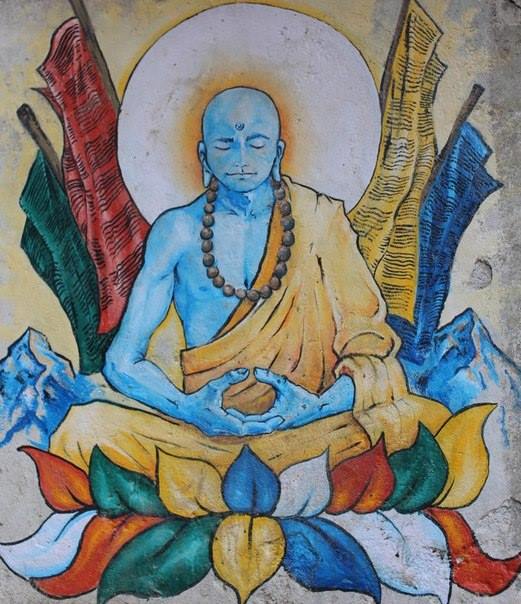
Gaudapada was an Indian thinker and the teacher of Govinda Bhagavatpada (who sometimes is questionably identified as Patanjali), of whom Shankara was a disciple. Gaudapada is considered founder of Advaita Vedanta, an Indian philosophical and religious school.
Gaudapada’s life
Gaudapada (other names: Gaudacharana, Gaudapadacharya, Gaudacharya, Sri Gaudapada, Gauda) is a historical figure, but very little is known about his real life. Some sources say that he lived in the fifth century AD, some – in the sixth to seventh centuries, others – in the late seventh to early eighth century AD. Everything suggests that he lived in Bengal.
The works of Gaudapada contain the first systematic presentation and interpretation of Advaita Vedanta. They greatly impacted Shankara and Advaita in general.
Gaudapada's philosophy was much influenced by Buddhism, which at that time was widely spreading. So some of his ideas are closely related with the principles of the madhyamiks (the Shunyavada theory).
Gaudapada's views contain so many Buddhist ideas that many of his commentators literally had to explain what the founder of Advaita Vedanta had exactly had in mind. Even Gaudapada himself specifically emphasized that his ideas were not those of Buddha (as he did, for example, at the end of the Mandukya Kariki).
Some, like Dasgupta, say that the philosopher was not a hinduite at all: "Gaudapada was a buddhist and composed the commentary on the Mandukya Upanishad in order to unite Vedanta and Buddhism, as, in his opinion, Buddhism was quite consistent with the Upanishad system”.
According to a legend recorded in the 13th century by the advaitist Anandagiri, Gaudapada "began his activity with a long ascetic practice (tapas) in the Himalayas, where, after pleasing Nara Narayana (Vishnu) in Badarikashram, he obtained permission from Vishnu to spread the teaching of Advaita Vedanta passed to him by the legendary sage Shuka.
Following that, Gaudapada started to write the Mandukya Kariki and became (according to Balakrishnananda, an even more recent vedantist of the 17th century) a teacher of the Gauda people who lived along the banks of the Hiravati River in the North Bengal”.
Without doubt, Mandukya Kariki is Goudapada’s most significant work, which has survived to this day and has been translated into many languages (including Russian). This text essentially laid the foundation of Advaita Vedanta.
Moreover, Gaudapada is believed to have composed a commentary on the Uttara gita (the Second Gita). He also wrote tantric texts, such as his commentary on Nrisinhatapaniya Upanishad and the Durgasaptashati (a 700-shloka poem dedicated to Durga).
The Sutra of the Treasure of Knowledge (Srividyaratna-sutra) is another work attributed to Gaudapada.
Gaudapada may have been the author of several other tantric works.
Gaudapada was the Paramguru (i.e., great teacher, or the teacher of the teacher) of the famous Shankara.
Source: http://worldreligion.info/hind_advaytavedanta_1
Contacts of "Worldwide Sanatana Dharma Community":
Omkar +380684188899 (Telegram, Viber, Whatsapp)